October 5, 2016

Bogota by bicycle

I arrived safely in Colombia, after about 28 hours of travel and flight delays that resulted in a missed connection and a long layover in Mexico City. I arrived at my hostel, Alegria's Hostel, around 10:30pm and promptly showered and passed out. I was mentally exhausted but physically restless. I can only handle sitting in airports and in airplanes for so long. I slept insanely well though, and woke up this morning ready to move. 

Since I only have one full day in Bogota, I decided to sign up for a city tour, something I usually wouldn't do because 1) I'm a cheapo and 2) I prefer to explore at my own pace. However, there are a few companies in Bogota that offer city tours via bicycle, which is perfect considering I wanted to see as much as I could while getting exercise. Plus, Bogota is famous for being accessible to cyclists with the most designated bike paths of any city in the world and weekly events during which main streets are closed so that people can bike without worrying about car traffic. I went with Cerros Bike Tours, a company recommended by my hostel. Apparently, since Lonely Planet has recommended the other main company, Bogota Bike Tours, their tours are overcrowded, whereas Cerros is newer and has not yet made it into the world of travel guidebooks. Thus, their tours are much smaller. I ended up being the only person in my tour, which meant I got to pay the group rate (~$12 USD) for a 4 hour private tour. My tour guide, Jose, spoke both English and Spanish, but since I want to practice my Spanish, we spoke mostly in Spanglish. We started in La Candelaria, the historic section of town, and made our way through various neighborhoods and parts of the city. The tour included a stop at a market, where I got to try about 6 new types of fruit - dragon fruit, pitaya, guayabana, guava, tomato del arbol, and some others I can't remember the names of. We stopped in the Parque Nacional and had a refreshing fruity drink under a unique species of palm tree that grows at high elevations. We continued on to a street famous for its graffiti, which is legal and abundant in Bogota, and Jose explained the cultural significance of many of the pieces. Later, we visited a coffee roasters where I drank the most delicious americano of my life. It was so good I didn't even add cream or sugar. Throughout the entire tour, we'd stop at historic places and Jose would share the history of each location. He rattled off an impressive list of dates and events for each location. What I got from it was that Bogota has lots of old buildings, many of which were built in the mid 1800's, in which many people have been murdered during hundreds of years worth of internal conflict. Jose noted that this week is an especially fascinating time to be in Colombia, with the public's rejection of the peace deal agreed upon by the FARC guerrillas and the government. He said the country is polarized, but overall ready for peace. The eagerness for peace is clear in much of the graffiti, which depicts scenes of war an destruction alongside images of hummingbirds, Colombia's national bird, and other nature scenes which Jose said represent the  internal conflict between war over resources and the desire to simply live and let live.

I was impressed by the amount of bike lanes in Bogota, and the general ease of navigating the city by bike. While Bogota is far ahead of many US cities in its bike accessibility, there are constant reminders that you're in Latin America. Many cars spew black exhaust and never use turn signals. Stray dogs run alongside the traffic and vendors walk between cars at traffic lights selling bottled waters and snacks. In some of the streets, pedestrians, bicyclists, and cars weave around one another in no obvious traffic pattern. I almost go hit by cars twice; luckily my bike had great breaks and I was wearing a helmet. I am thankful for my experience biking in Guatemala, where every day for about 10 months I would bike to school on a crowded road without a shoulder. My 10 year old self thought that I was going to die at least a dozen times per commute. My general cycling experience in the US made the tour much less nerve wracking than I think it would have been otherwise. 

I spent the rest of the afternoon wandering around Bogota by foot. Besides my bike tour, my favorite part of the day was visiting the Museo de Oro (the gold museum) which is packed with pre-Colombian artifacts. 

Tonight, I'll grab a beer with some new friends from the hostel, and tomorrow morning, I'll head back to the airport where I'll meet up with Hana, aka Lil H-Busse, and we will fly north to Santa Marta for a week of scuba diving and sunshine. 


September 19, 2016

A love letter to Kodiak

Dear Kodiak,

Today, I sat at the end of the Spruce Cape trail in awe. It was an ordinary overcast Kodiak day, yet your beauty and wildness was abundant. Two humpback whales spouted off the point, and glaucous winged gulls crowded the surface of the water above where the whales swam. More gulls and oyster catchers perched on the rocks below the cliff face I sat on, gossiping loudly. A curious harbor seal emerged from the water, upsetting a raft of ducks.

The ground I sat on was eroded enough for the thick layer of volcanic ash from the 1912 Novarupta eruption to show through. I thought about time, and how fascinating it is that the eight inches (more or less) of volcanic ash -- the majority of which was deposited onto you within two days of the eruption -- is almost the same thickness as the soil that has been created through natural processes of decomposition and weathering in the last 104 years since the eruption. I wondered how old the rocks the gulls and oystercatchers sat on were, and I wished I had taken more geology.

A lone stand up paddle boarder paddled towards the opening of the bay. Because of the lighting, they looked as though they were walking slowly but purposefully on top of the water. I thought of Jesus because apparently he walked on water, but that's about as far as I got on that thought because I know less about the Bible than I do about geology.

I sat there, under a branch of the toughest little deformed Sitka spruce tree, a tree that has withstood so many storms, and that is about to withstand another big one this week, and thought about how much goodness I came into this summer. So many good experiences and good people. I graduated college, moved home to work my dream first post-grad job, I was taken in by my community and I was able to save lots of of money by housesitting for people who have really nice houses but decide, for some insane reason that I will not question but instead be grateful for, to leave them in the summer time. I ate your delicious salmon and home grown veggies gifted to me by friends. I saw your bears, mountain goats, foxes, whales, sea otters, puffins... more wildlife than I will probably see in the entire next year. I climbed your mountains, swam in your lakes, walked on your beaches, kayaked to your islands, slept outside, peed outside, and pooped outside (no disrespect, Kodiak). SO MANY GOOD THINGS!

I only have a week left with you, Kodiak, which is a bummer for many reasons, but especially because the dog I've been watching for the last month has finally begun to listen to me when I tell him, "Please stop eating that rotting dead animal you found in the woods", in my most assertive voice. Here's to the good things that make this island home: the people, the plants, the fish, the bears, the ocean. Kodiak, it'll be two years until I'll be able to come back to you but believe me, babe, you'll be on my mind.

XOXO,
Anelise


September 16, 2016

Wild Geese

September is a month of change. In nature, animals follow their homing instincts and in society, humans cringe with the knowledge that change is right around the corner come election day. Like the humpback whales and arctic terns that are about to embark on their long journeys south, September means migration season for me, too. Twelve years ago this week, my family moved to Guatemala to live there for a year. Two years ago this week, I returned to Central America to live there for the semester. Both these moves tremendously influenced the development of my sense of self and place. Within the next two weeks, I will head south again, in hopes that I will absorb even more goodness and knowledge from the world. Unlike the migrating terns, humpbacks, and geese, I will be traveling via overcrowded airplanes and buses. However, like any of the migrating animals, I am traveling because it is what I must do to thrive. 

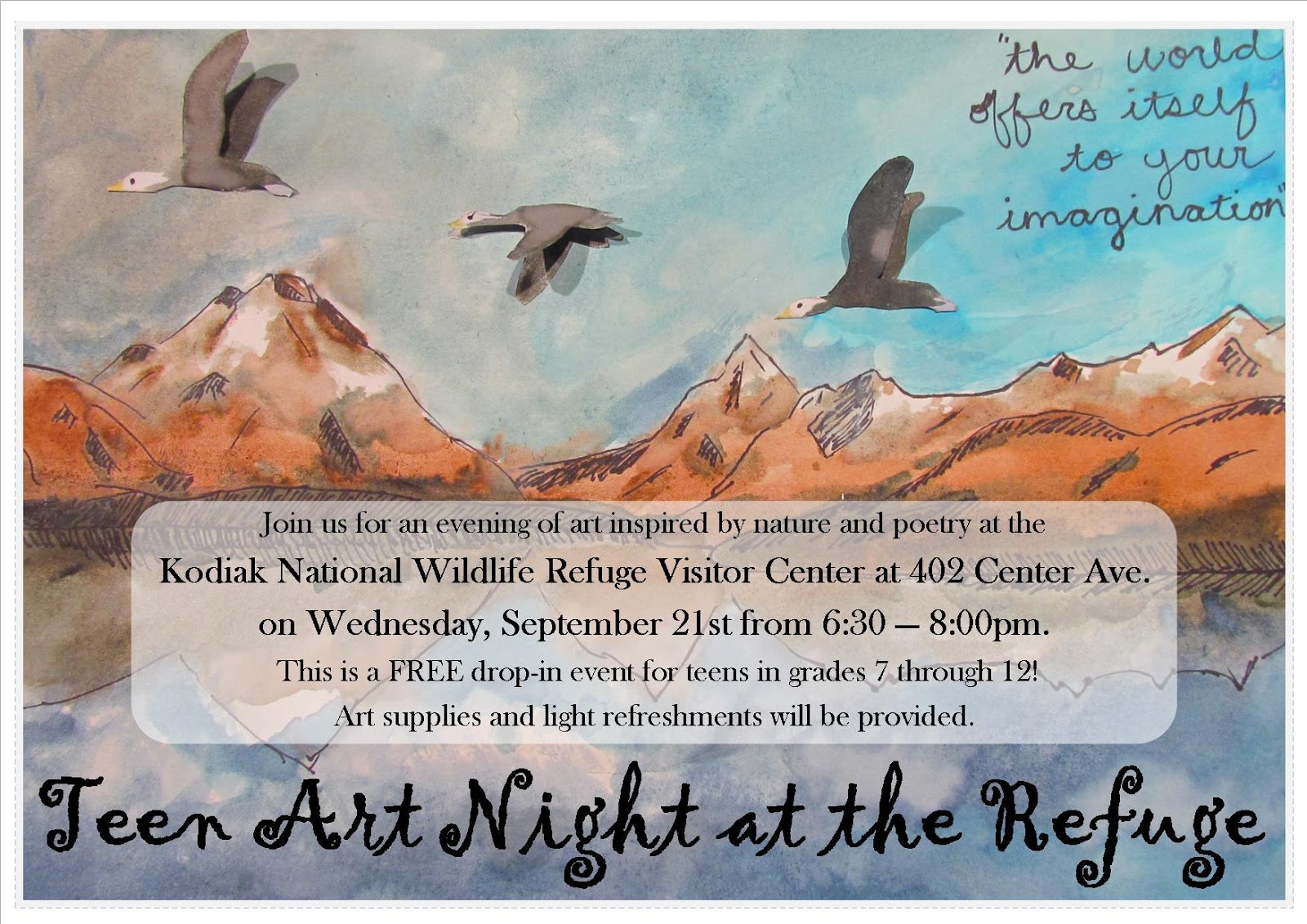
On the themes of migration and sense of place, I'll be hosting a teen art night at my work next week to make ink and watercolor art inspired by Mary Oliver's poem, "Wild Geese". Enjoy her poem, shared below, and please share my flyer with any teens in Kodiak who may be interested in attending next week.

"Wild Geese" by Mary Oliver

You do not have to be good.
You do not have to walk on your knees
For a hundred miles through the desert, repenting.
You only have to let the soft animal of your body
love what it loves.
Tell me about your despair, yours, and I will tell you mine.
Meanwhile the world goes on.
Meanwhile the sun and the clear pebbles of the rain
are moving across the landscapes,
over the prairies and the deep trees,
the mountains and the rivers.
Meanwhile the wild geese, high in the clean blue air,
are heading home again.
Whoever you are, no matter how lonely,
the world offers itself to your imagination,
calls to you like the wild geese, harsh and exciting --
over and over announcing your place
in the family of things.


August 30, 2016

Up next: Idaho... Colombia, Peru, and Bolivia!

I've found that post-grad life consists of constantly dreaming up new possibilities. Well, that was pre-grad life too, but now the difference is that I finally have the time and just barely enough money to make those dreams happen.

I'm a sucker for taking advantage of opportunities, and when else may I have an oddly spaced 7 week gap that happens to coincide with really good flight deals to South America? Probably never. So, I bought a ticket to Bogotรก, Colombia and I'll have 7 weeks this October and November to work my way through Colombia, Peru, and Bolivia. The trip will be bookended (providing I buy a return ticket... hehe) with visits to Moscow, Idaho, where Sebastian is attending graduate school. 

In December, I'll visit my mom, dad, and brother in the United Arab Emirates and visit Abu Dhabi, Dubai, and hopefully Oman and Kuwait. In early January, I'll move to Malaysia to begin my ten-month placement as a Fulbright English Teaching Assistant. While in Malaysia I'll have the opportunity to explore Southeast Asia.

I am so excited for the next year and a half of my life, but with so many intriguing plans for the future I constantly have to remind myself to live in the present. Tonight, instead of researching South America as I am extremely tempted to do, I am filling by belly with fresh sockeye salmon and preparing for a nap because the Aurora Borealis forecast looks promising tonight and I want to see them before I head indefinitely towards the equator. 

Golden hour captured during a recent backpacking trip to Shelly Lake.

August 26, 2016

What It Means to Love a Place

My all time favorite essay about place is "What It Means to Love a Place" by Kathleen Dean Moore. I first heard of Moore when assigned to read "The Night of the Razor Clam Tide" from her book, The Pine Island Paradox, for an environmental ethics class at university. I fell in love with Moore's writing, partially because her essay's presence stood out in a class that consisted mostly of lengthy essays written by dead white men (no offense, Thoreau and Leopold), but more notably for her ability to call me home to a place of peace when I was buried deep in the stress of school. 

I received The Pine Island Paradox this spring as a birthday gift from my sweet friend Hana, who also connected with Moore's work. While on a spring break backpacking trip in the Maze District of Canyonlands National Park, I first read "What It Means to Love a Place" aloud to my adventure buddies, Sebastian and Sam. We were nestled in our tent, a hundred miles from civilization, smelling of sweat and salami and covered in a thick layer of fine orange desert dust. My headlamp flickered and the wind snapped at our tent. Despite the novelty of the desert solitude, I was completely at home in the comfort of the tent, surrounded by two of my closest friends.

This summer, as I've walked and kayaked along the coastlines of Kodiak, as I've made new friends and reconnected with those from years ago, and as I've missed my family who now lives in Abu Dhabi, Moore's essay has come to mind many times. I've tussled with the paradox of loving Kodiak while the people that make the place so special to me live halfway across the globe. While my love for Kodiak has always been rooted in the natural beauty of the place -- the green moss that drapes lazily on spruce trees, the barnacles and sea stars that decorate the intertidal zones, the song birds that erupt from the alders when I hike past -- my family's presence in Kodiak plays a significant role in what makes me love it here. Since they've moved, my definition of "family" has expanded to include friends, friends' parents, and other people's dogs. I admire Moore's ability to communicate her understanding of love for both people and places, and I've attached my favorite portions from the essay. Read more at Kathleen Dean Moore's website.

Love has as its object: daughter, son, young woman who loves son, sudden quiet, a certain combination of smells (hemlock, salt water), mist swimming with light, purple kayak, fog-bound island, hidden cove, and the man who can drive a boat through any squall. The list is, of course, incomplete. Add silver salmon. Add unexpected sun.

 I stretch my back and start two lists. What does it mean to love a person? What does it mean to love a place? Before long, I discover I've made two copies of the same list. To love – a person and a place – means at least this:
  Number One: To want to be near it, physically.
  Number Two: To want to know everything about it – its story, its moods, what it looks like by moonlight.
  Number Three: To rejoice in the fact of it.
  Number Four: To fear its loss, and grieve for its injuries.
  Number Five: To protect it – fiercely, mindlessly, futilely, and maybe tragically, but to be helpless to do otherwise.
  Six: To be transformed in its presence – lifted, lighter on your feet, transparent, open to everything beautiful and new.
  Seven: To want to be joined with it, taken in by it, lost in it.
  Number Eight: To want the best for it.
  Number Nine: Desperately.

 I know there's something important missing from my list, but I'm struggling to put it into words. Loving isn't just a state of being, it's a way of acting in the world. Love isn't a sort of bliss, it's a kind of work. To love a person is to act lovingly toward him, to make his needs my own. To love a place is to care for it, to keep it healthy, to attend to its needs. Obligation grows from love. It is the natural shape of caring.

 Number ten, I write in my notebook: To love a person or a place is to take responsibility for its well-being.  I turn the rowboat toward camp, tugging on the clanking oars, scattering reflections, picturing my family gathering one by one to explore the bay as the tide falls. They will be stumbling over rocks and calling out to one another. "Look, here, under the kelp." 


Adapted from Kathleen Dean Moore, The Pine Island Paradox (Minneapolis: Milkweed Editions, 2004), 34-36. Copyright © 2004, Kathleen Dean Moore

August 14, 2016

A short story of me crying like a baby in public

I was taught a lot of things at Willamette University. How to do multiple linear regressions, that professors are real people too, and that the best college jobs hook you up with free food and/or get you outdoors. I was even informed that graduation would be simultaneously one of the most rewarding and saddest days ever, and that not going back to school the following fall would be weird.

However, no one, not a single soul, warned me about the tsunami of sorrow that would hit me at approximately 11:19pm while at the Warm August Nights. It was time to say goodbye to Robyn and Courtney, who I grew up with in Kodiak and who too, decided to attend Willamette. While saying goodbye, I had two sudden realizations.

One: my little WU babies are going back to school without me I won't get to see their smiling faces everyday. Seriously, these two, Robyn and Courtney, are my pride and joy and I'm so happy they chose Willamette because I have been able to watch them make that community a better place just in their first two years there.

Two: I will not be returning to the place into which I poured an exorbitant amount of energy during the last four years. This August, I get to do something other than prepare for another semester of school, which is a great feeling, but it seems unnatural, since the last 16 or so Augusts of my life have consisted of a back-to-school ritual.

So, with a rock band and a mosh pit in front of us, and an enormous bonfire behind us, I sobbed -- the kind of sobbing that makes your breath shaky and you think you might need an IV because of all the water loss via tears -- and hugged Robyn and Courtney and told them (not quite as eloquently) what I really wish people had drilled into my head when I was half-way through college:

Do what makes you happy. Do not feel bad saying no to anyone/anything that requests your energy but does not fill you with a sense of accomplishment or joy. Your energy is valuable and you deserve to keep some for yourself. Have fun!

Robyn and Courtney waited for hours in the graduation 
tent to save my family the best seats. Gotta love these girls.


August 13, 2016

Reset

I last wrote of feeling truly uprooted -- a feeling I'd not felt before. Housing plans had fallen apart while friends were visiting, and I scrambled to find us a place to stay. I was worried that my guests would have a less than perfect time because of my inability to host them the way I had initially planned.

I momentarily regretted my decision to come "home" for the summer. What even is home if you don't have a consistent place to stay, when you are living in other people's houses while they are on vacation? I am facing a reality that I had previously hoped to disprove. Home really does have something to do with a specific place. The old wood stove, the view of the mountains, the strangely placed stained glass of an iris above the toilet, the buoy swing in the yard, the stream I built dams in as a kid, the beach a quarter mile through the woods. It has to do with the people, too; sitting at the dining room table with my parents and brother for hours after we had finished dinner, laughing and telling embarrassing stories about one another. I shouldn't forget the dogs, the cats, the chickens, and the (briefly lived) goats and bunnies, either. Nor the bears eating the chickens, the dogs eating the bunnies, and the eagles trying to eat the cats.

After that pathetic week of self-pity, my job whisked me away and I had the chance to reset while in Blue Fox Bay of Afognak Island. I slept in a tent all week long, ate most of my meals outside in the rain, and used a particularly aromatic outhouse. Along with my work crew of four teenagers and my incredible boss, Shelly, I got to hike a new mountain, on which we found centuries old bear tracks that are imprinted in the alpine moss. We explored the beaches and a nearby creek, ate wild blueberries, water colored, and watched a tiny vole nibble on grass only a few feet away.

Since my trip to Blue Fox, I feel reset. I'm once again pleased with my decision to return home to Kodiak for the summer. To top it all off, this past Sunday, I had the opportunity to hike to Shelly Lake on Sharatin Mountain for my first time with Shelly and Kari, two women I look up to very much.

It is easy for me to forget how incredibly privileged I am, and that is something I need to work on. Despite being geographically far from my family and living out of a duffle bag in someone else's home, I've got it really, really good. In this community of Kodiak I know that I will always have a roof over my head. I have an incredible job and amazing role models. I can afford to eat well and I have time to exercise, read, and write. My legs carry me up mountains. Most importantly, I have parents that no matter how far away they are, support and love me. I have it so. freaking. good.

While the end of July was emotionally challenging, I'm thankful to have come to terms with the fact that for me, home is at least partially place-based. Still, this is only a teeny, tiny piece in the puzzle of finding home in the (un)familiar.

Bear tracks on Devil's Paw Mountain on Afognak.

Shelly Lake on Sharatin Mountain in Kodiak.